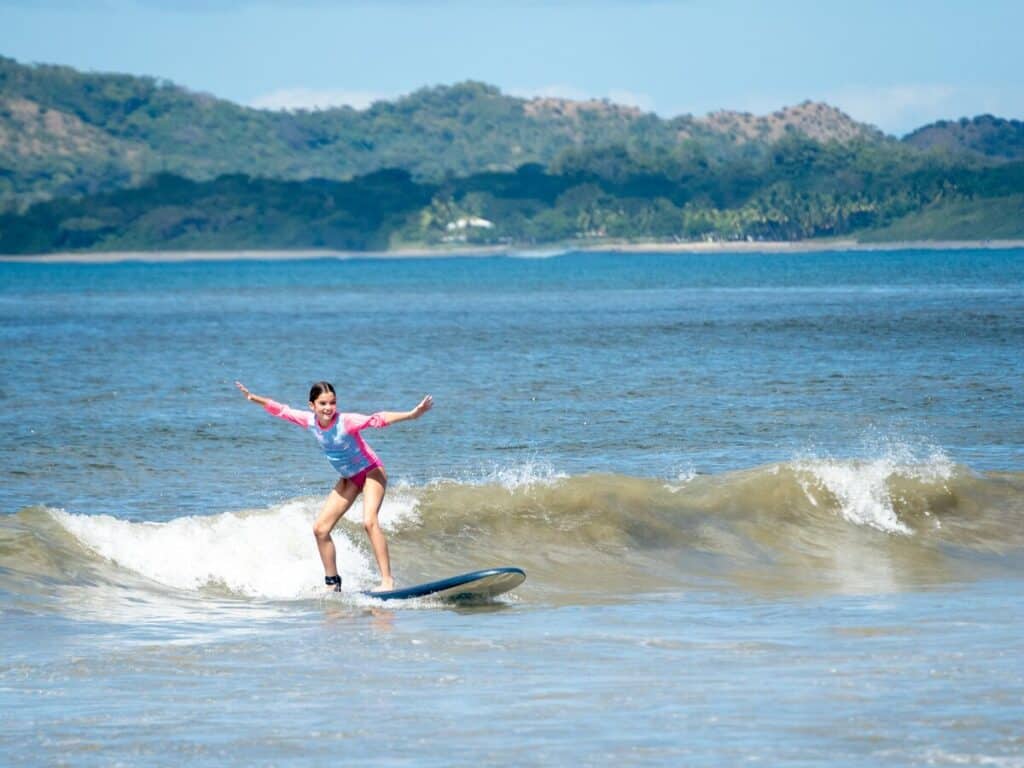
Tamarindo surfing works for almost every level. The main beach break in front of town has slow, rolling waves over sand. That makes it one of the easiest places in Costa Rica to learn. Experienced surfers have reef breaks and a river mouth in the same bay, plus stronger waves at Playa Grande, Avellanas and Playa Negra.
We’re Tamarindo Guide, a free local business directory for Tamarindo, and we’ve lived here for over 10 years. This is the surf guide we’d give a friend: where to paddle out for your level, when the waves are good, what lessons cost and how to stay safe. For the rest of your trip, see our local’s guide to Tamarindo and more things to do in Tamarindo.
Is Tamarindo good for beginner surfers?
Yes, Tamarindo is a good place for beginner surfers. The waves in the middle of the bay break slowly over sand, and the water is warm all year. Many surf schools teach on the beach every day, and many first-timers stand up in their first lesson.
Why beginners do well here
- Soft waves over sand: the main beach break is gentle on most days. Falling on sand hurts much less than falling on rock.
- Warm water: the ocean is usually 27 to 30°C (81 to 86°F), so you don’t need a wetsuit.
- Lessons everywhere: surf schools line the beach and the main road, and most lessons include the board.
The honest downside is crowds. The beginner zone fills up with lessons in high season (December to April), so go early in the morning.
The main surf spots in and near Tamarindo
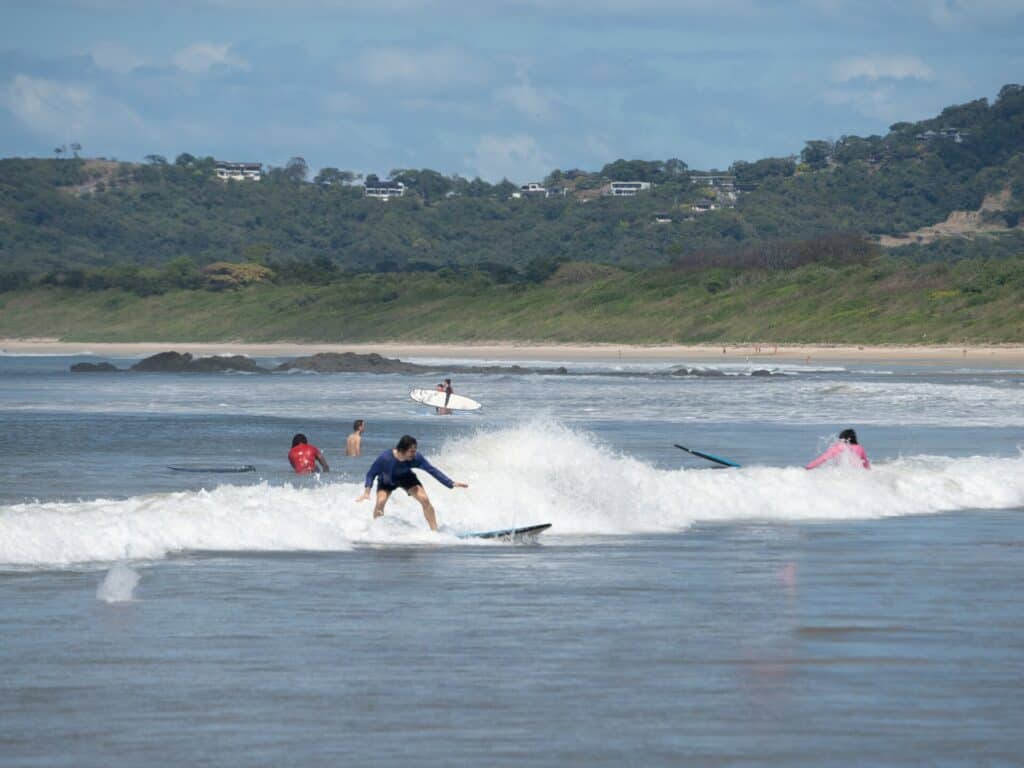
Tamarindo Bay has a sandy beach break for beginners, two reef breaks for better surfers and a river mouth wave at the north end. Most spots work better from mid to high tide. For beaches outside town, see the day trips section below.
Surf spots in Tamarindo Bay
- The main beach break: long, slow waves over sand in front of town, where most lessons happen. Level: beginner. Tide: mid to high; at low tide the waves close out faster.
- The south end, toward Langosta: schools take students here when the middle is crowded. The waves are often smaller. Level: beginner.
- Pico Pequeño: a rocky reef break in the middle of town. It’s a single peak that gets crowded and is shallow at low tide, so most people surf it near high tide. Level: intermediate.
- Pico Grande: a more powerful reef wave farther out, with a steep drop. It needs a bigger swell. Level: advanced.
- The river mouth (El Estero): fast lefts and rights over sandbars where the estuary meets the ocean. The sandbars move, so the wave changes over the year. Level: advanced.
- Playa Langosta: the next beach south, past the rocks, with reef and river mouth peaks. The waves are faster than in Tamarindo. Level: intermediate and up.
A note about crocodiles at the river mouth
American crocodiles live in the Tamarindo estuary, at the north end of the beach. They stay mostly in the estuary and the mangroves, and it’s rare to see one on the main beach. The river mouth wave is close to where they live, so follow a few simple rules.
- Surf the river mouth only if you’re experienced, and never alone.
- Don’t surf it at dawn, at dusk or at night.
- Don’t walk or paddle across the river mouth to Playa Grande. Take a boat across instead.
When is the best season for surfing in Tamarindo?
You can surf in Tamarindo all year, so the right season depends on your level. The dry season (December to April) has smaller waves and offshore winds, which suits beginners. The green season (rainy season), roughly May to November, brings bigger, more regular swells.
Dry season: December to April
- Waves: usually small to medium on the beach break.
- Wind: offshore winds blow from the land most mornings and often longer. They keep the waves clean.
- Who it suits: beginners and longboarders. The reefs are often too small for advanced surfers.
- Water: still warm, though windy days can feel cooler. Some surfers wear a thin neoprene top.
- Crowds: it’s high season, so the lineup is at its busiest.
Green season: May to November
- Waves: bigger swells from the south and southwest. The reefs, Playa Grande and Playa Negra work more often.
- Wind: mornings are often calm and glassy. The wind usually turns onshore in the afternoon, and storms are common.
- Who it suits: intermediate and advanced surfers. Beginners can still learn on smaller days.
- Rain: September and October are the wettest months.
What time of day should you surf?
Early morning is usually the cleanest time to surf, all year. The wind is lighter, the sun is softer and there are fewer people in the water. Check the tide too, since high tide comes about 50 minutes later each day.
How to read the Tamarindo surf forecast and tides
A surf forecast tells you how big the waves are, how strong they are, which way the wind blows and what the tide is doing. You don’t need a paid app. Free forecasts and tide tables are enough for a surf trip.
What each number means
- Swell height: the size of the waves, usually in feet. For beginners, 1 to 3 feet is plenty. Over 5 feet, the beach break gets hard and the reefs get serious.
- Swell period: the seconds between waves. Around 12 seconds or more means stronger, cleaner waves that break harder than the height suggests. Under 9 seconds means weaker, messier waves.
- Swell direction: Tamarindo faces west, so southwest and west swells reach the bay well.
- Wind: offshore wind blows from the land to the sea and makes waves clean. In Tamarindo, that’s an east or northeast wind. Onshore wind comes from the sea and makes waves bumpy.
- Tide: the times of high and low tide. The difference is often more than 2 meters (about 7 feet), so a spot can change a lot in a few hours.
Where to check
- Surfline: the free version shows a basic Tamarindo forecast. Magicseaweed, an older free site, closed in 2023 and is now part of Surfline.
- Live cameras: the website of Witch’s Rock Surf Camp, a surf hotel on Tamarindo Beach, streams live beach cameras with a tide table.
- Ask a surf school: instructors know which spot is working today.
Our tip: for most spots in the bay, aim for the 2 to 3 hours on either side of high tide. Low tide exposes rocks at Pico Pequeño and in a few spots on the beach.
Renting a board vs. taking lessons
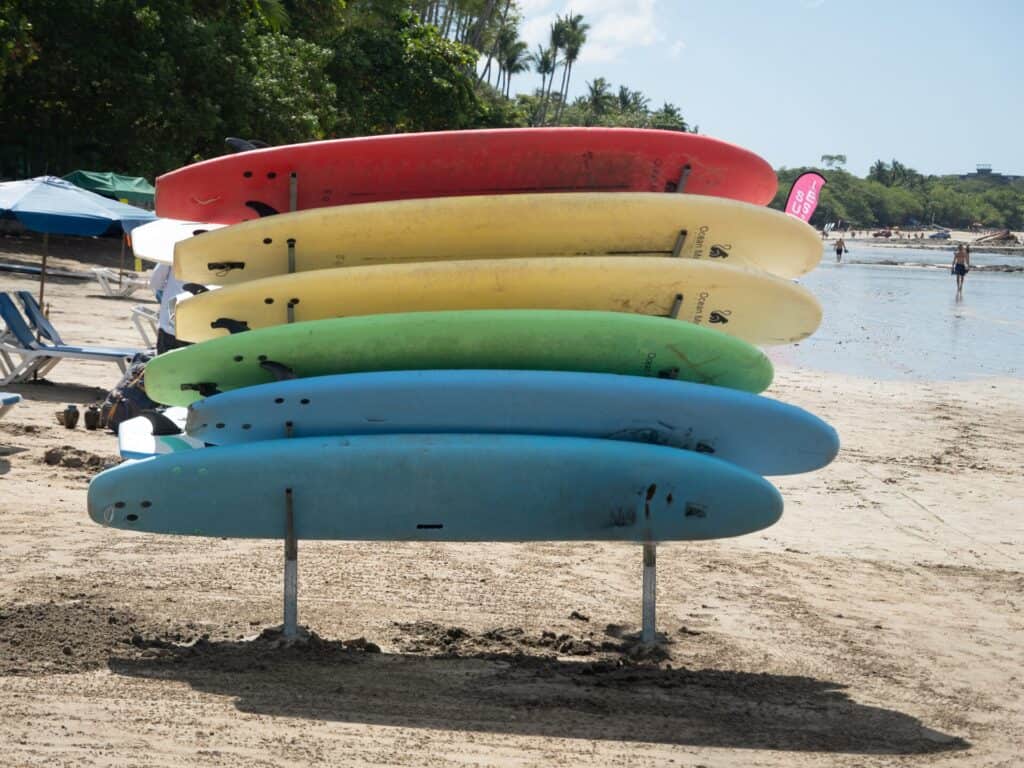
If you’ve never surfed, take at least one lesson before you rent a board. The instructor covers safety, paddling and standing up, and picks the right spot for the day. If you already know the basics, renting is cheaper and gives you more time in the water.
Surf lesson prices
Typical prices for a 2-hour lesson in Tamarindo, from surf school websites (as of October 2026):
- Group lesson: about $50 to $70 per person.
- Semi-private lesson (2 students): about $60 to $80 per person.
- Private lesson: about $70 to $115 per person, depending on the school and tax.
- Packages: 3, 5 or 7 lessons often cost less per lesson.
Most lessons include a soft-top board and a rash guard. Some schools price in colones (₡), the local currency, and a tip for your instructor is common. To compare schools, see our list of Best Surf Lessons in Tamarindo, ranked by 4- and 5-star Google reviews.
Board rental prices
- By the hour: some shops rent by the hour, with prices starting around ₡6,000 (about $12).
- By the day: usually about $15 to $30.
- By the week: most shops give a lower daily rate (all prices as of October 2026).
Prices change by shop and board. Many shops on the main road also sell wax, leashes and rash guards. Browse surf shops in Tamarindo to find one near your hotel.
What gear to bring or rent
- Soft-top board: a foam board that floats well, catches waves easily and doesn’t hurt much if it hits you. Beginners should start around 8 to 9 feet long.
- Rash guard: a stretchy surf shirt that protects you from the sun and from rubbing on the board.
- Reef booties: thin rubber shoes for rocky spots like Pico Pequeño and Playa Negra. You don’t need them on the sandy beach break.
- Reef-safe sunscreen, a hat and water: the sun is strong, even on cloudy days.
Surf etiquette and safety in Tamarindo
The main rule of surfing is one surfer per wave. The surfer closest to where the wave breaks has the right of way, and everyone else stays off it.
Surf etiquette
- Don’t drop in: if someone is already riding the wave, or is closer to the peak, don’t take off on it.
- Paddle around, not through: when you paddle out, go around people riding waves, not into their path.
- Hold on to your board: a loose board can hit someone behind you.
- Know your level: beginners should stay in the whitewater, away from the reef peaks.
- Take turns: at busy peaks like Pico Pequeño, don’t paddle around everyone to get every wave. A friendly hello in the water helps too.
Safety tips
- Rip currents: strong currents that pull water away from the beach, more common when the waves are bigger. If one pulls you out, don’t fight it. Paddle parallel to the shore until you’re out of it, then come back in. NOAA has a clear guide to spotting and escaping rip currents.
- Stingrays: in shallow, sandy water, shuffle your feet as you walk in. It warns stingrays to move away.
- Storms: in the green season, get out of the water when you hear thunder.
- Valuables: don’t leave phones, keys or bags on the sand or in your car. See our Tamarindo safety tips.
Day trips to Playa Grande, Avellanas and Playa Negra
When Tamarindo is small or crowded, three nearby beaches often have bigger waves and more space. Playa Grande is across the estuary to the north. Playa Avellanas and Playa Negra are about 30 to 40 minutes south by car.
Playa Grande
- What it is: a long, open beach break that picks up more swell than Tamarindo. The waves are faster and more powerful.
- Level: intermediate and up.
- Getting there: take a short boat ride across the estuary from the north end of Tamarindo Beach, or drive around in about 25 minutes.
- Good to know: Playa Grande is part of Las Baulas National Marine Park, where leatherback turtles nest. The beach is open 6am to 6pm. In nesting season, from October 20 to February 15, it closes at 5pm, according to Costa Rica’s official tourism board. For current rules, ask the Las Baulas National Marine Park office in Tamarindo.
Playa Avellanas
- What it is: a quiet beach with several peaks, from softer beach break waves to reef breaks.
- Level: all levels on small days. The reef peaks are for intermediate and advanced surfers.
- Tide: usually better from mid to high tide.
- Good to know: the last part of the road is dirt.
Playa Negra
- What it is: a right-hand reef break over dark rock, a little south of Avellanas.
- Level: intermediate and advanced. It gets hollow and powerful as the tide drops.
- Tide: usually better from mid to high tide.
- Good to know: wear reef booties for the rocks and sea urchins. There are no lifeguards, so don’t surf alone.
There’s no regular bus to Avellanas or Playa Negra. Many surf schools run surf trips with transport and a guide, or you can see car rentals in Tamarindo to drive yourself.
Boat trips to Witch’s Rock and Ollie’s Point
Witch’s Rock (Roca Bruja) and Ollie’s Point are two well-known waves in Santa Rosa National Park, in the far north of Guanacaste. Going by boat makes it a full-day trip from Tamarindo.
- Witch’s Rock: a beach break at Playa Naranjo, in front of a large rock. It can get big and hollow. Level: intermediate and advanced.
- Ollie’s Point: a long right-hand point break about 10 km farther north. It needs a solid south or southwest swell, so it’s mostly a green season wave. Level: advanced.
- How the trip works: most trips drive about 1 hour north to the boat at Playas del Coco or Playa Panamá. The boat ride takes 1 to 2 hours. Some boats leave from Tamarindo or Playa Flamingo.
- Cost: a private boat costs several hundred dollars for the day, split between the surfers, plus a park fee per person (as of 2026). Ask if lunch, drinks and the park fee are included.
- Park permit: boats need permission from the national park. Ask your operator to confirm a current permit before you pay.
- Good to know: crocodiles have also been seen near the river mouth at Witch’s Rock. Many tour agencies in Tamarindo and surf schools book this trip.
Tamarindo surfing FAQ
Are there crocodiles where you surf in Tamarindo?
Crocodiles live in the Tamarindo estuary at the north end of the beach, not in the main surf zone. They’re rarely seen on the main beach. Beginners should surf the middle and south of the bay, and nobody should surf the river mouth alone or at dusk.
Do you need a wetsuit to surf in Tamarindo?
No, you don’t need a wetsuit in Tamarindo. The water is usually 27 to 30°C (81 to 86°F). A rash guard is enough for most people.
How much does a surf lesson cost in Tamarindo?
A 2-hour group surf lesson in Tamarindo costs about $50 to $70 per person, as of October 2026. Private lessons cost about $70 to $115. Most include the board and a rash guard.
Which town in Costa Rica is good for surfing?
It depends on your level. Tamarindo is one of the easiest places to learn, with soft waves, many surf schools and a walkable town. Experienced surfers can add day trips to Playa Grande, Avellanas and Playa Negra for stronger waves.
Ready to paddle out? Find surf lessons and board rentals in Tamarindo, all listed free on Tamarindo Guide.
Something out of date in this guide? Tell us and we’ll fix it.